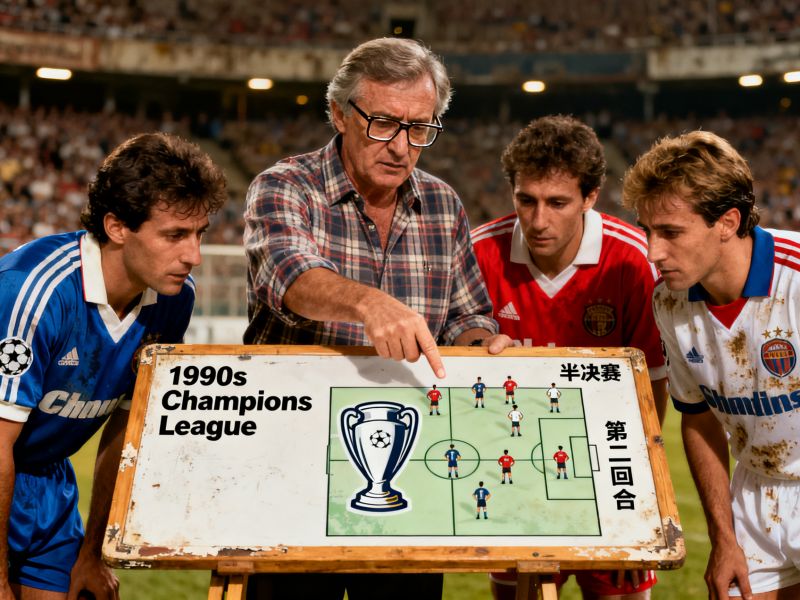
Ottmar Hitzfeld won the Champions League with two different clubs—Borussia Dortmund in 1997 and Bayern Munich in 2001. That fact alone should make any coach pay attention. He didn’t do it with flashy formations or endless tactical experiments. He did it by mastering the quiet arts: reading a squad’s psychology, building a spine of reliable players, and knowing exactly when to switch from patient possession to ruthless counterattacking.Watch Dortmund’s 1997 final against Juventus. Hitzfeld set up a compact 4-4-2 that absorbed pressure, then released Karl-Heinz Riedle and Andreas Möller on quick transitions. Juventus had Zidane, Deschamps, Vieri—and still lost 3-1. Hitzfeld’s plan wasn’t revolutionary. It was precise. He identified that Juve’s full-backs pushed high, so he drilled his wide midfielders to tuck in and spring forward the moment possession turned over. That level of detail—studying an opponent’s habits and exploiting one or two weaknesses—is something any grassroots coach can copy。even without world-class players.Man-management mattered just as much. Hitzfeld famously benched a young Thomas Müller for months at Bayern。
then told him exactly what to improve: off-ball movement and finishing under pressure. Müller later said Hitzfeld’s blunt honesty saved his career. Contrast that with coaches who rotate players randomly and offer vague feedback. Hitzfeld kept a small core of leaders—Matthäus, Effenberg, Kahn—and gave them real authority in the dressing room. He didn’t micro-manage personalities. He let strong characters police each other, stepping in only when the line was crossed. That approach works in amateur football too: pick two or three senior players you trust, tell them the standards, and let them enforce them.Tactically, Hitzfeld was a pragmatist. At Bayern, he shifted between a 4-4-2 and a 3-5-2 depending on the opponent’s width. Against Barcelona in 1999, he used a back three to crowd out Figo and Rivaldo, then hit long diagonals to Jancker and Basler. It wasn’t beautiful. It was effective. His teams rarely pressed high for 90 minutes—they pressed in smart bursts, usually after a backward pass or a heavy touch. That saves legs and reduces exposure. If you coach a team with average fitness。adopt that principle: trigger the press only when the opponent’s body shape is poor, and drop back into a mid-block otherwise. Hitzfeld’s Bayern conceded fewer than 30 goals in three of his four full seasons—not because they had the best defenders, but because they rarely got caught out of shape.One last lesson from Hitzfeld: he never overreacted to a single result. After a 3-0 loss to Lyon in 2000, he kept the same back four for the next six matches. They won five and drew one. Modern coaching culture pushes constant tinkering—new formations, new lineups, new training methods every week. Hitzfeld showed that stability, when paired with honest feedback and a clear game model。beats chaos. For anyone coaching at any level, the Hitzfeld blueprint is simple: pick a system that suits your players, drill two or three counterattacking patterns until they’re automatic, and spend more time talking to your players than drawing arrows on a whiteboard.